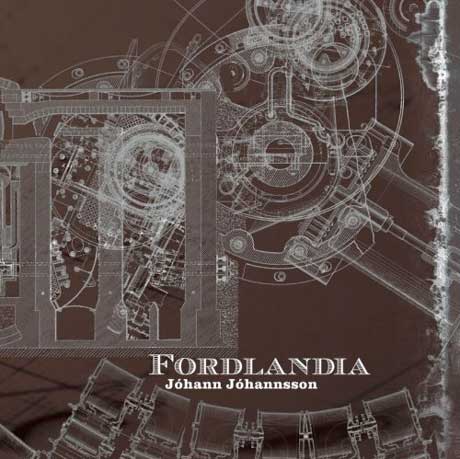
Jóhann Jóhannsson: Fordlandia
By Sam Lee /// published in the December 2008 issue
To the uninitiated, this sort of music often sounds like the score for some unknown film. The implication is that the music is lacking — as if, like some kind of amputated limb, it is nearly useless without its visual accompaniment. The music is reduced to “soundtrack music,” written off as pretty, emotional, and empty, without consequence.
It is a peculiar thing. This is music that creates images and pictures; here the visual is far more prominently evoked than in any pop song, yet it requires an actual visual counterpart to be successful? No, it shouldn’t, and it doesn’t, when done well. Indeed, music this visual can be, and often is, more expressive without any film accompaniment. Music without words can rarely be specific, and this is precisely when it is most emotive.
In this vein, Jóhann Jóhannsson’s Fordlandia plays off broad, sweeping themes extracted from vague stories: Henry Ford’s failed utopian rubber plantation in Brazil, the lamentations of a Victorian poet, the explosive death of a rocket scientist, the possibilities of faster-than-light travel. One can imagine Jóhannsson’s music scoring a film version of any of these stories, but it would lose something. By introducing the stories without much explanation, they become less about fact or history and more about connotation and feeling. The album revels in ambiguity; it is music without words but with narrative, only the narrative is unclear and interpretable. Here, specificity will always be elusive.
This is Jóhannsson’s most remarkable achievement. He creates enduring atmospheres that are, more than anything, seem location-based destinations. The album is a mode of transportation, and it the world it takes the listener to is one where you are forced to linger. The album’s opening and closing tracks, “Fordlandia” and “How We Left Fordlandia,” are obvious examples of this deliberation, totaling nearly thirty minutes together, but even Jóhannsson’s shorter pieces manage to create the same effect. The album is versatile, leisurely winding its way through lush, elegant string passages, glorious crescendos, ominous overtones, and electronic dabblings. Throughout, the composer’s confidence is apparent, with both the album’s most epic moments and its smallest treated with impeccable care and control.
Jóhannsson is nearly as ambitious as Ford himself, and unlike the automobile magnate, his dreams are for the most part realizeased. Jóhannsson manages to unite his previous work in one encompassing achievement.; Over the course of the album, the lush openness of IBM 1401: A User’s Manual (2006) blends beautifully with the exploratory, often dark nature of 2002’s Englaborn, Jóhannsson’s solo debut. On his website, Jóhannsson writes of the album as a juxtaposition, almost in an alchemical sense, of human ambition, technology, and nature. Just as alchemy produces something new from its reactants, Jóhannsson’s end result is not necessarily about the specific themes he started with, but the flowing ambiguity he ends with. The world he creates is one in flux, with countless opposing forces pushing, pulling, and never triumphing.
Jóhannsson’s only weakness is a tendency towards perfectionism, surfacing occasionally over the duration of the record. At times, the music seems too lush, too pristine, losing the emotionality of what is truly a beautiful work. On the record’s opening track, “Fordlandia,” the contrast between the piece’s sweeping, grandiose climax and its superb denouement illustrates both sides of Jóhannsson’s remarkable orchestral work. The climax, coming amidst slow, churning strings and an echoing guitar, is almost too beautiful for its own good, bordering on the trite. Contrarily, the song’s final five minutes are a flourishing continuous ritardando, giving the listener ample time to stop and linger — this slowing is where Jóhannsson’s imagery is most elegant.
What Jóhannsson does best is craft vast soundscapes, weaving a huge tapestry from countless emotions and sources. It is intelligent and profound, but never overbearingly so. With Jóhannsson’s help, the listeners can lose themselves in a glorious world cordoned only by of their own interpretations. Fordlandia was never meant to accompany the images of a film, but to create them.
Comments
Leave a commentNo comments!